© 2017 - Best Computer Case For Bitcoin BTC Mining
Note: Our guide on Bitcoin mining has been fully updated. This feature was first published in November 2015. Mining is the process of using a computer to perform complex calculations on blocks of data which maintain the Bitcoin network. Miners are rewarded for their efforts with a certain amount of. Bitcoin (BTC) is fast becoming the province of people using specialized (application-specific integrated circuit) devices, although if you have one or more powerful graphics cards you may still be able to generate a small profit by assembling your own mining device. You'll learn more about this in the following steps.
Professional 6/8 GPU Magnalium Alloy Miner Case Open Air Mining Frame Rig Graphics Case. Professional 6/8 GPU Magnalium Alloy Miner Case Open Air Mining Frame Rig Graphics Case GPU ATX for Crypto Coin ETH/ETC/ZCash ZEC XMR Ethereum,Bitcoin,and Altcoins with Lock 10 Fans. Have any Bitcoins. Sure, you could go to a Bitcoin exchange. An everyday computer rig. So, what’s a budding Bitcoin. Series of Bitcoin mining. Jun 9, 2017 - I had been entertaining the idea of building an Ethereum mining rig for months and the price surge in May made it seem like as good a time as any to begin the process. So I sold some of my Ether, bought some computer hardware, and set to work learning about building PCs and the art of Linux. Nov 24, 2017 - The second reason is the conversion rate. In the case below, you can insert an annual profitability decline factor that will help you estimate the growing difficulty. Conversion rate – Since no one knows what the BTC/USD exchange rate will be in the future it's hard to predict if Bitcoin mining will be profitable.
The actual profit you make will depend on a number of factors. The first is your 'hash rate' – in other words, the actual processing power of your machine.
Computers designed for mining, or 'rigs' as they're commonly known, require large amounts of electricity, which will increase running costs. The complexity of mining also rises over time. Keep your Bitcoin wallet anonymous, protect your mining bounty from pirates With super fast servers in 90+ countries & apps for all devices, ExpressVPN provides unrivaled speed, reliability, security & unblocking. Try risk free today with an exclusive 49% discount and a 30-day money-back guarantee!
The Bitcoin itself is a very volatile virtual currency and while it has recently made huge gains, it may also plummet in value. Bear this in mind if you plan to hold onto any BTC you mine rather than selling immediately. If you want a rough idea of how much you can make from mining, use one of the many online profitability calculators (for example, the one at ).
While you can technically try to mine Bitcoin on your own, it's very unlikely that your rig will singlehandedly solve the complex sums necessary to receive a reward. Instead, you'll need to join a mining pool.
As the name suggests, this is a pool of multiple machines connected together, engaged in a collaborative mining effort. The Bitcoin rewards reaped are shared amongst everyone who contributed processing power to the effort. However, note that the way in which profits are shared can vary from pool to pool. You can learn more about pooled mining on the. • If you just want to buy bitcoin instead, check out as well as a list of the. Prev Page 1 of 15 Next Prev Page 1 of 15 Next 1.
Choose your miner. One easy – but not cheap – way to get started with Bitcoin mining is to buy an ASIC device such as the AntMiner S9.
These devices have been specifically designed for mining Bitcoins which means they'll generally give you the greatest return on your investment. However, as mentioned, these ASIC devices are expensive. The S9 for instance currently retails for around €2,100 (about £1,860, $2,490).
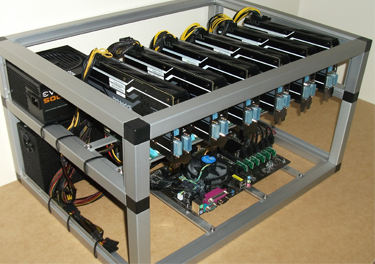
You will usually need to buy a separate power supply unit which will set you back something like another €300 (£265, $360). These devices are usually designed specifically to mine Bitcoin and will not function well if you try to use them to mine other cryptocurrencies (if, say, Bitcoin should happen to fall drastically in value). Alternatively you can build your own Bitcoin mining rig. While these aren't as efficient in terms of power and hash rate, they require less upfront expense and can mine other currencies besides BTC. In the simplest terms these are computers with multiple powerful graphics cards installed. These GPUs might be primarily designed to render complex graphics when playing games, but they also lend themselves well to coping with the complex calculations involved in Bitcoin mining.
To get started, you'll need to purchase a case for the machine. Most of these are a simple metal frame to allow heat to dissipate easily. You'll then need to choose a motherboard and graphics cards for mining, such as the AMD Radeon RX 580. If you need some more advice, see our guides on choosing the and for mining.
You'll need to assemble the machine and install the OS and mining software yourself, so you should only go down this route if you are tech-savvy and familiar with computers. If neither of these options appeals, you can rent hash power from cloud mining companies. These firms have dedicated data centers devoted to mining Bitcoins. As they are centralized they can buy machines in bulk and use efficient methods to generate electricity. Most companies will offer you a fixed amount of Gigahash Seconds (GH/s) of mining power for a fee. Open Source Gulden NLG Miner. The advantage of this approach is that you don't need to buy any expensive hardware.
The fees for cloud mining will vary, however, and another point to be wary of is scammers posing as cloud mining outfits. See the for a list of reputable cloud mining companies.
Image credit: Marco Krohn (Wikimedia Commons) Prev Page 2 of 15 Next Prev Page 2 of 15 Next 2. Set up your Bitcoin wallet. Once you've made the decision that mining is right for you, you'll also need to set up a Bitcoin wallet to store your profits. If you're mining as an investment and don't plan on spending any of your coins soon, consider using a website like to create a 'paper' wallet. Make a note of the 'public' address which you can use to receive payments. You can check the balance of your Bitcoin wallet safely at any time by visiting and entering your payment address into the search bar at the top-right. Don't let anyone see your private keys as anyone with access to your paper wallet can control your virtual cash.
If you plan to regularly cash out your BTC or make payments, consider using a software wallet instead. The lightweight is available for all major desktop operating systems and Android. When you create your wallet, Electrum will generate a 'seed' of a dozen random words to use as a private key.
This means you can restore your Bitcoin wallet if anything happens to your computer. If you use a software wallet like Electrum, try to do it on a machine that isn't connected to the internet so your BTC can't be hacked. This is known as 'cold storage'. The Electrum website has for setting up a 'watching' wallet for day-to-day use which can show your balance but cannot make payments itself. Or for full instructions on setting up secure offline storage, see our article on. Prev Page 3 of 15 Next Prev Page 3 of 15 Next 3.
Pick a Bitcoin mining pool. Head over to the and click on 'Sign up here' at the top-right. On the registration page choose a username, then enter your email address and password. The Slush Pool website will send you a confirmation email. Click the link to validate your email address.
You'll see that a 'worker' has been created for you, so you can begin mining. Although it's not compulsory, you should ideally have one worker per device. Visit at any time to view and create workers.
Prev Page 5 of 15 Next Prev Page 5 of 15 Next 5. Funded mining. You need to tell your mining pool where and when to send the funds from your mining exploits.
On the Slush Pool website you can do this by clicking 'Settings' at the top-right, then click 'Bitcoin' on the left. Choose 'Payouts' then click the 'New Wallet' button. Paste in your public address for Bitcoin payouts here. If you're using a paper wallet this should be clearly marked. In Electrum you can view your current receiving address by clicking on the 'Receive' tab. Click 'Submit' when you're done. Some miners also allow you to choose the payout threshold – in other words how many BTC you need to have mined before the Pool sends funds to your wallet.
This is important as while it's risky to leave large amounts of BTC in an online wallet, transaction fees for sending BTC across the network are currently very high, so you could end up paying a lot for multiple smaller payments. Choose freely and wisely. Prev Page 6 of 15 Next Prev Page 6 of 15 Next 6. Mining pools are a popular target for hackers for obvious reasons. To make sure no one can potentially pilfer your Bitcoins, first check that your pool uses SSL. This means your connection is secure – in most web browsers you'll see a padlock icon (in the address bar) if this is the case. Certain mining pools such as Slush Pool also allow you to secure access to your account by using two-factor authentication.
This introduces a second step for a successful login, and is therefore another hurdle to prevent hackers from breaking into your account. In order to use this you'll need access to a mobile device and an app such as Google Authenticator or FreeOTP. Prev Page 7 of 15 Next Prev Page 7 of 15 Next 7. Grab Bitcoin mining software. Whether you're using a specialized ASIC Miner or your own rig, the device is going to run very hot when trying to mine BTC for you. Therefore, be sure to place your mining hardware somewhere with good ventilation so the heat can dissipate easily.
Generally speaking, the cooler your mining machine, the more efficiently it will perform. Make sure to factor the costs of air conditioning and/or a heat pump into your mining calculations to be certain you’re still running a profitable enterprise. If you live somewhere cold, you could follow in the footsteps of and use the excess heat from mining as a 'data furnace' to heat your home. Prev Page 14 of 15 Next Prev Page 14 of 15 Next 14. Keep mining profitable. As research continues into specialist mining equipment and the difficulty of mining increases, the highest profits from mining are usually earned by data centers based in locations where energy is inexpensive such as China. As a hobbyist miner, you can maximize your profits by following their example by using ASIC miners and keeping electricity costs down.
While relocating to China may not be on the cards, you can increase the efficiency of your rig by using an efficient PSU. You can get help with this in the Pools section of the. An alternative way to get one over on the ‘big bully’ miners is to use renewable energy to power your mining machine – for example by installing solar panels on your property. If you do this, remember that the advertised wattage for devices is usually the optimal amount you'll receive under ideal conditions. Solar panels in particular are affected not just by the amount of sunlight they receive, but by surface area, the angle at which they're placed, and the direction in which they're facing. Speak to a qualified installer, fully explain your needs, and get things right. To get started, consider using an electricity usage monitor to measure the energy consumption of your mining device in kWh (kilowatt hours).
These are very inexpensive and available from any hardware store. Remember that the reward for mining Bitcoin halves every 210,000 blocks. You can find a more detailed explanation of this on the, but essentially, this means mining becomes less profitable over time, unless you can increase your hash rate – or the value of Bitcoin increases. Image credit: Thamizhpparithi Maari (Wikimedia Commons) Prev Page 15 of 15 Next Prev Page 15 of 15 Next • • • • •.
We’ve talked about before, and even put together a list of. But a list of places to spend Bitcoins isn’t of much use if you don’t have any Bitcoins. Sure, you could go to a Bitcoin exchange such as Mt.Gox and exchange your money for Bitcoins, but there’s always security risks involved in doing so. If you decide to mine Bitcoins yourself, it’d probably take you forever just to mine one Bitcoin using an everyday computer rig. So, what’s a budding Bitcoin enthusiast to do?
Well, if you’re serious about getting into Bitcoin, and don’t want to deal with the potential dangers of online Bitcoin exchanges, then there’s only one thing left to do: invest in a Bitcoin mining machine. These are purpose-built computers where the one and only aim is to mine as many Bitcoins as possible, as quickly as possible. Read Also: Intrigued? Here’s a list of 5 machines that will be shipping in the near future. Make sure you have some cash to burn!
Recommended Reading: 1. Fast-Hash One There are three machine models in the of Bitcoin mining machines: the Silver Edition, the Gold Edition and the Platinum Edition.
These are 19″ rack mountable Bitcoin machines, with the main differences being their expandability and the power of the included mining modules. All three machines come with one mining module, but can be upgraded to have six.
The Silver Edition is powered by a 64 GH/s module and tops out at 384 GH/s. The Gold Edition is powered by a 128GH/s module, with a maximum hash rate of 768GH/s. The Platinum Edition comes with the most powerful 256 GH/s module, and can go up to 1.536TH/s. Overall, when fully upgraded, these machines will mine anywhere from 0.2 up to 0.85 Bitcoins a day. While the Silver Edition does not support expansion cases, both the Gold and Platinum Editions support up to six expansion cases, with each expansion case able to hold up to 16 modules, for even more mining power. The Fast-Hash One mining machines are available for pre-order. Price: $2,499 – 5,999 for base units 2.
CoinTerra TerraMiner IV is a water-cooled Bitcoin mining machine powered by CoinTerra’s own in-house ASIC chips, the GoldStrike I. The TerraMiner IV is built on a 28nm process and comes in a 4U enclosure with a power supply included, which is a rarity in Bitcoin mining circles. The TerraMiner IV has four ASIC chips, and with each boasting a 500 GH/s hash rate, it means that the TerraMiner IV has a total hash rate of 2TH/s. At the current mining difficulty, that translates to just over 1.1 Bitcoins a day. CoinTerra also claim that the TerraMiner IV is power efficient, although there are no numbers available yet to prove this claim.
The April batch for the TerraMiner IV is open for pre-orders. Price: $5,999 3. Hashfast Sierra is a high performance water-cooled Bitcoin mining machine powered by three Golden Nonce ASIC chips. It is built into a 4U rack mountable case and comes with two Seasonic power supplies built in. The Sierra has a nominal hash rate of 1.2 TH/s, which translates to about 0.66 Bitcoins a day as of the time of writing. The thing with the Sierra, though, is that it doesn’t have an on-board controller, so you’ll have to connect the Sierra to a main control unit via USB.
This main control unit can be anything that will run CGminer, a mining software. The Hashfast Sierra is open for pre-orders and is guaranteed to ship by March 31, 2014. Price: $6,300 4. Black Arrow Prospero X-3 is powered by 20 Black Arrow Minion ASIC chips built into a 19″ rack mount unit.
The Minion ASICs are built on a 28nm process and are an in-house design. The Prospero X-3 will also have a built-in LCD display that will show statistics and diagnostics. The 20 Minion ASIC chips in the Prospero X-3 give it a hash rate of 2TH/s, good for about 1.1 Bitcoins per day as of the time of writing. The Prospero X-3 has been designed with up to 20% under- and overclocks in mind. It also supports the lightweight Stratum mining protocol. The Prospero X-3 is available for pre-order and is scheduled to be available at the end of February 2014. Price: $6,999 5.
KnCMiner Neptune The is quite possibly the grand daddy of all Bitcoin mining machines. The Neptune is basically four modular 20nm ASIC boards, designed so that the machine will continue mining even if one (or more) of the boards fails. How To PACcoin PAC Mine For Free.
The Neptune follows up from their previous miner, the Jupiter, which was built on a 28nm process. The Neptune has a minimum hashing speed of 3TH/s, which translates to about 1.66 Bitcoins a day.
This is a vast improvement on the Jupiter, which was only able to mine 0.6 Bitcoins a day. KnCMiner also mention that they have the right to increase the speeds as it nears shipment, so the Neptune might end up being even faster once it gets into miners’ hands. The KnCMiner Neptune is currently available for pre-order, and is scheduled to begin shipping in Q1/Q2 of 2014, limited to 1200 units.
Price: $12,995.
Coments are closed